
A flat is the biggest purchase most families ever make, so nobody buys after one advert. A typical buyer sees a Facebook post, sends a WhatsApp message, calls the hotline a week later, visits the site with family, asks for a price list, goes quiet for a month, and comes back only if someone follows up at the right moment. Developers rarely lose these buyers to a better project. They lose them to a missed call-back.
This article shows where real estate leads leak, what a CRM (customer relationship management system) actually changes for a sales team, and a simple follow-up routine you can start tomorrow, with or without software.
Where leads leak in a real estate sales team
- No single list. Enquiries arrive through Facebook, WhatsApp, the website form, the hotline and walk-ins at the site office, and end up in five places: a notebook, a salesperson's phone, an inbox.
- A slow first reply. A buyer who messages three developers usually talks seriously to the one who answers first. Research published in Harvard Business Review (Oldroyd, McElheran and Elkington, The Short Life of Online Sales Leads, 2011) found that most companies do not respond to online enquiries nearly fast enough.
- Silence after the site visit. The visit is the warmest moment in the whole process, and it is often followed by nothing at all.
- Contacts leave with the salesperson. When someone changes jobs, their leads and the history of every conversation leave with their phone.
- No idea which advert sells. You know how many messages a campaign brought, not how many of those people booked a flat.
What a real estate CRM changes
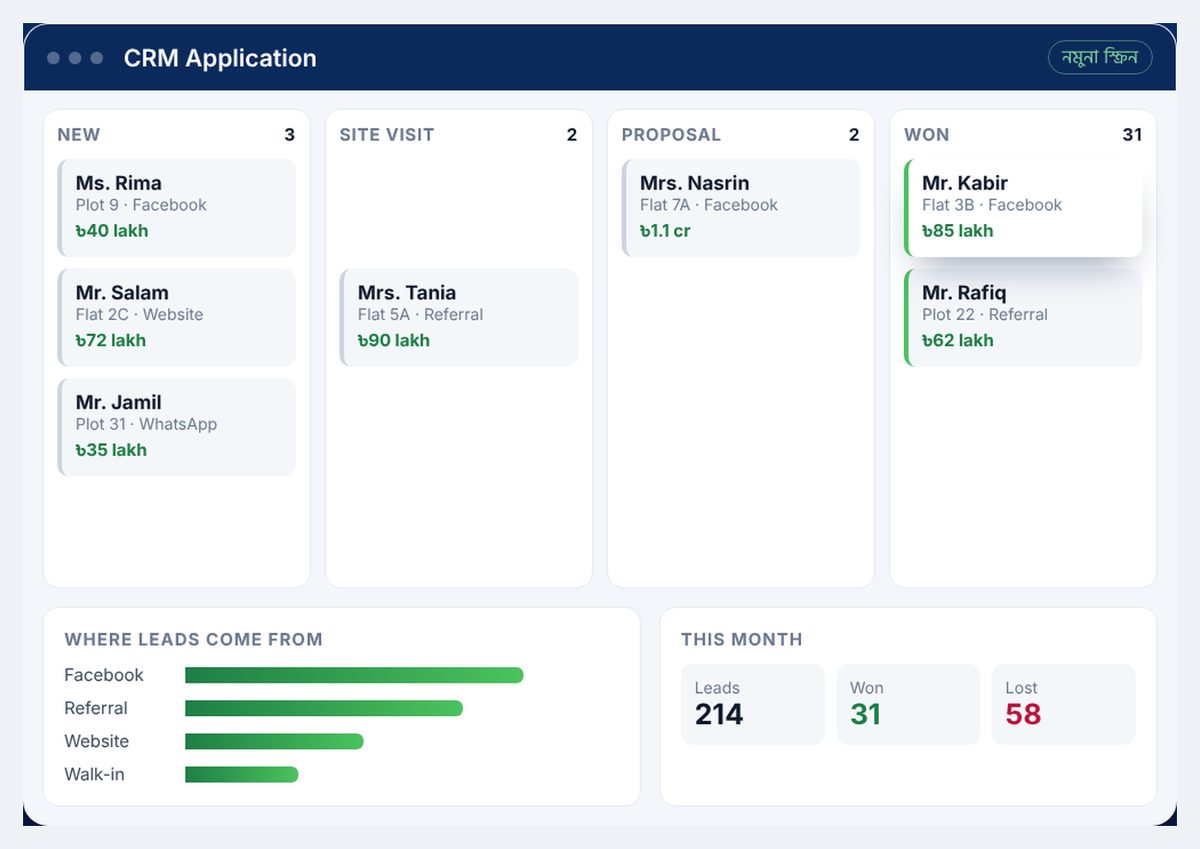
1. One inbox for every lead
Website, Facebook, WhatsApp and manually entered leads land in a single queue, and each one has an owner.
2. A pipeline you can see
Every buyer moves through clear stages: new, site visit, proposal, negotiation, won or lost. A manager sees at a glance where deals are stuck and what each stage is worth.
3. Follow-up reminders
Every lead gets a next step and a date. Each salesperson sees today's calls, so nothing depends on memory on a busy day.
4. The whole conversation in one place
Calls, notes, the price list that was sent, the flat the buyer liked: all on the buyer's record, so anyone in the team can pick up the conversation.
5. Source reports
See which campaign or channel actually closes deals, not just which one brings messages, and plan the next advertising budget around it.
6. Team performance
Leads handled, response time and win rate per person. Useful for coaching, not only for targets.
A simple follow-up routine for flat sales
- Reply within the hour. During office hours, answer every new enquiry within the hour: a short WhatsApp reply with the project, its location and one question about what the buyer needs.
- Offer a site visit with two time options. "Saturday at 11 or Sunday at 4?" gets more visits than "come any time".
- Call the day after the visit. Ask what the family thought, and send the floor plan and payment schedule they asked about.
- Set the next step before you hang up. Every conversation ends with a date for the next contact.
- Write down why deals are lost. Price, location, handover time, a competitor. After a few months these notes tell you more than any survey.
You can start this routine with a shared spreadsheet. A CRM makes sure it still happens when the team is busy, when someone is on leave, and when you have 300 leads instead of 30.
From booking to accounts: the handover that matters
A won deal is where the accounts team takes over: booking money, the instalment schedule, receipts and reminders. If sales and accounts keep separate lists, the same flat can be promised twice or an instalment can be missed. Our Real Estate Accounting software keeps projects, units, bookings and instalments in one system, and the CRM, the accounts software and your website can be connected if you need it (quoted separately). For the accounts side, read our Bangla guide: instalment accounting, Excel or software?
What to check before you choose a CRM
- Can it bring in leads from your website form and Facebook without retyping?
- Does it work well on a phone? Salespeople spend their day at site offices, not at desks.
- Who owns the data, and can you export it at any time?
- Is training included, and who answers when something goes wrong?
- Can you see a working demo with your own pipeline stages before you pay?
Frequently asked questions
Is a CRM worth it for a developer with one or two projects?
If leads are being forgotten, or the owner is the only person who knows where every buyer stands, yes. The value comes from follow-ups that actually happen, not from the size of the company.
Can we see it before buying?
Yes. We show the real system in a 20-minute screen-share demo, free of charge.
Do you also build real estate websites?
Yes. See our checklist for a real estate company website (in Bangla) and the real estate and construction websites we have built.
Want to see it with your own projects? See the CRM in detail or book a free demo.
Cover photo: Unsplash